Sealed Hyperthermia: The overlooked reason why a clean man can still smell down there
Why washing more never solves it, and what dermatological science actually says is happening.
It is one of the most confusing problems in a relationship, and one of the least talked about. A man showers every day, sometimes twice. He is, by any measure, clean. And within an hour, the smell is back. His partner notices. He usually cannot. And both of them, more often than not, quietly conclude the same wrong thing: that it is a hygiene problem.
It almost never is. What follows is the actual physiological mechanism behind it, drawn from dermatological and anatomical science. Once you understand it, the two assumptions that cause so much silent damage, that he is not clean enough, and that she is being too sensitive, both fall apart completely.
1. The one thing everyone gets wrong: fresh sweat has no smell
This is the fact the entire mechanism turns on, and almost no one knows it. Sweat, at the moment it leaves the body, is odorless. This is true of both types of sweat gland. The eccrine glands, spread across nearly the whole body, produce a watery, essentially scentless sweat for temperature control. The apocrine glands, concentrated in only a few sites, the armpits and the genital-inguinal region chief among them, secrete something different: a thick, lipid-and-protein-rich fluid. But even that richer secretion is colorless and odorless when it emerges.
The smell is not the sweat. The smell is what happens to the sweat afterward.
2. The odor is manufactured by bacteria, not by dirt
Odor appears only when ordinary skin bacteria, chiefly Corynebacterium and Staphylococcus species, begin breaking down that apocrine secretion. They metabolize its lipids and proteins into volatile, sharp-smelling compounds: short-chain fatty acids such as 3-methyl-2-hexenoic acid, and, most pungent of all, sulfur-containing thioalcohols like 3-methyl-3-sulfanylhexan-1-ol, one of the most powerfully malodorous molecules the human body can produce, even in trace amounts.
This is the critical reframe. The smell is not a sign of filth. It is a normal biochemical reaction, and it requires very specific conditions to run at full speed: warmth, moisture, and an absence of airflow.
Why this matters: if the odor were dirt, soap would remove it and it would stay gone. It doesn't, because washing addresses the surface while doing nothing about the conditions that keep manufacturing the smell. That single distinction is where "just shower more" quietly fails.
3. Why the groin is uniquely vulnerable: a cooling system that gets overwhelmed
The genital region is not an ordinary patch of skin. It carries an unusually high density of apocrine glands, and it houses the body's scrotal cooling system, which must keep the testicles roughly 2 to 4°C below core body temperature. That system relies on a coordinated set of structures, the dartos and cremaster muscles, the counter-current heat exchange of the pampiniform plexus, and thin, gland-rich scrotal skin, all designed to shed heat.
That cooling architecture depends on one thing to work: the ability to release heat into the air. And that is exactly what gets taken away the moment a man gets dressed.
4. Sealed Hyperthermia: what actually happens inside the underwear
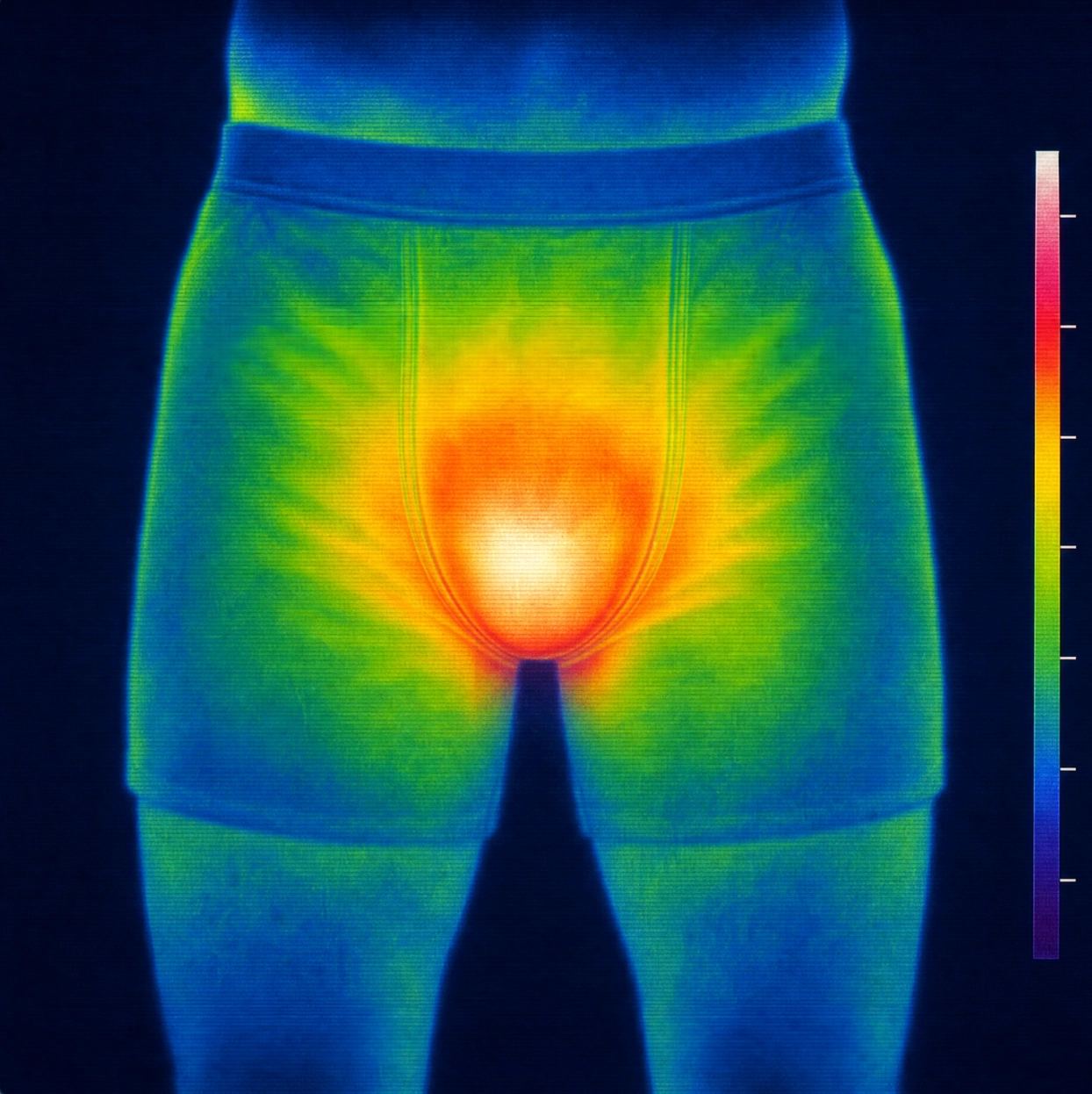
Here is the mechanism itself. When underwear presses fabric against the skin, it does three things at once. It seals the body's own internal heat (the body runs at 97°F; the heat source is internal, so this happens regardless of the weather outside) against the skin with nowhere to escape. It traps moisture, preventing the sweat from evaporating and cooling as it is designed to. And it cuts off airflow entirely.
The result is a warm, damp, occluded microclimate, sealed against the exact patch of skin that is densest in odor-producing glands. Studies have measured that fitted underwear produces a measurably higher scrotal temperature than loose cuts. In that sealed environment, the bacteria that manufacture the smell do not merely survive. Their recolonization is exponential, multiplying faster and faster across the fourteen-to-sixteen hours the underwear is worn.
This is Sealed Hyperthermia: the body's own trapped heat, combined with sealed-in moisture and zero airflow, turning odorless sweat into odor continuously, all day, on repeat.
The shower resets the bacterial count for a few minutes. Then he gets dressed, the microclimate re-forms, and by lunch it has rebuilt completely. He is not failing to clean. He is fighting a process that resets within the hour.
5. Why he genuinely cannot smell it, and she can
There is one more piece, and it is the one that ends the blame on both sides. The human nose habituates: it stops registering a constant smell, filing it as background and editing it out of conscious perception. It is the same reason a person cannot smell their own home, or their own perfume by midday. For an odor a man carries every hour of every day, this habituation is complete. He is not ignoring it and he is not careless. His own nervous system has removed it from his awareness entirely.
His partner, exposed to it only intermittently, registers it fully. So the one person positioned to notice is powerless to fix what he cannot detect, and the one who detects it is often too afraid of wounding him to speak. That is how something with a simple physical cause turns into years of silent distance.
6. Why it started when it did, and why stress makes it worse
Many couples remember it being fine at the start. That is not imagination. The apocrine glands are under sympathetic nervous control, which means they fire in response to stress, anxiety, and emotional load, producing a heavier secretion than ordinary heat-sweat. More sedentary hours, tighter or more synthetic fabrics, a hotter season, rising stress: any of these can switch a quiet microclimate into an active one. The man did not change. The conditions inside the sealed environment did.
What actually addresses it
Once the mechanism is clear, so is the requirement. Because underwear is worn every day for life, the sealed microclimate re-forms every single morning; this is not something that is cured once and forgotten. It is managed, daily, the way it is created, daily. And a shower alone cannot do it, because it treats the surface and leaves the conditions intact within the hour.
What the science points to is a topical approach applied directly to the skin that works on all three conditions at once: cooling the trapped heat (menthol acts on the TRPM8 cold-receptor pathway, the mechanism behind its genuine cooling and soothing effect), reducing the sealed-in moisture the bacteria feed on, and targeting the odor-causing bacterial load at the source, rather than layering fragrance over it. Supporting the skin barrier itself, with ingredients like aloe and hyaluronic acid, helps it recover from prolonged occlusion.
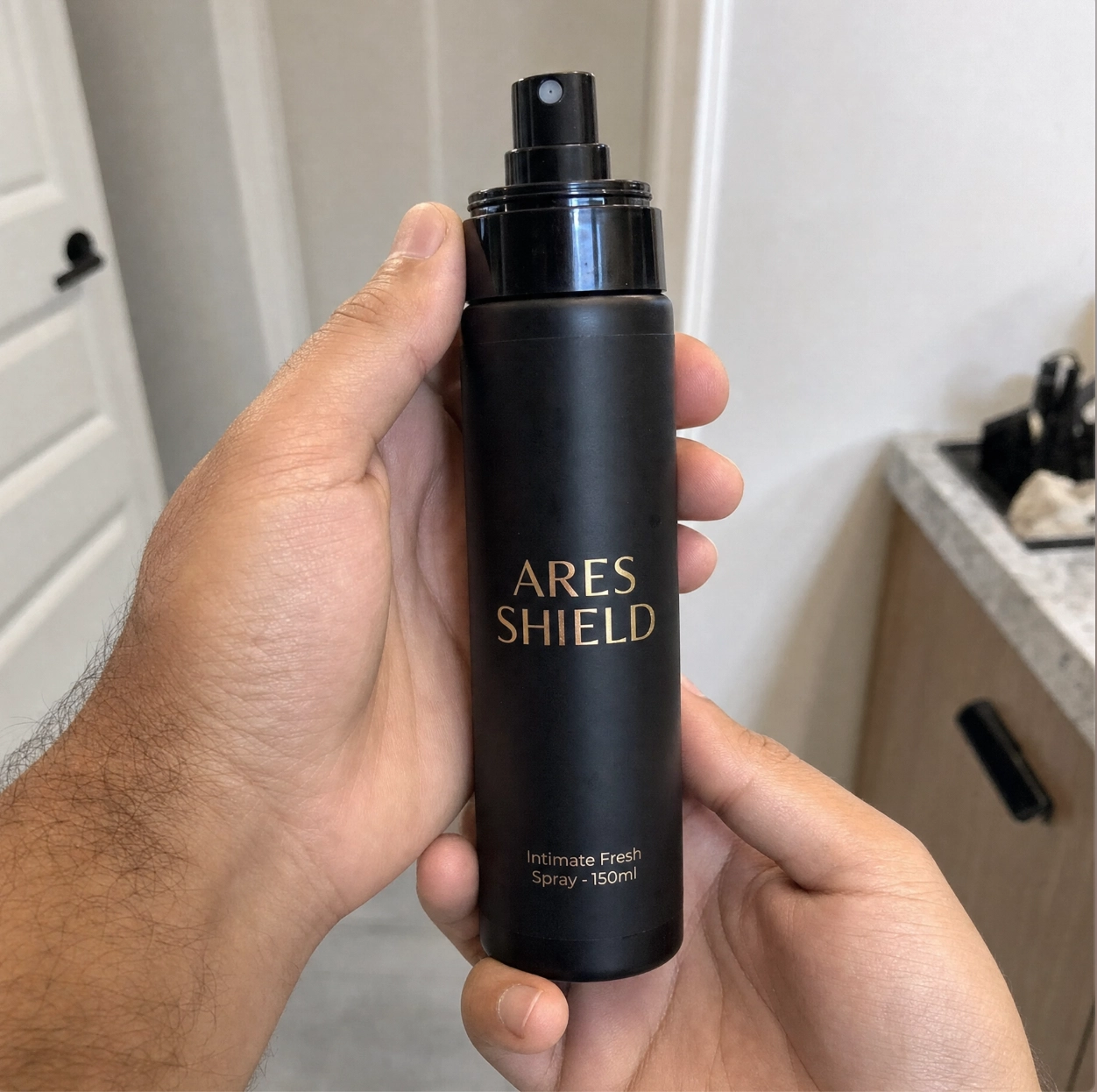
That is precisely the space ARES SHIELD was built for: a cosmetic freshness spray formulated for the sealed intimate zone, applied in seconds after the shower he already takes, going after the microclimate itself instead of the smell it produces.
Educational content only, based on dermatological and anatomical literature. Persistent odor, or any rash, itching, discharge, pain, or visible skin change, warrants evaluation by a qualified healthcare professional.